

Building Waterproofing Into the 2027 Capital Plan: What to Document Before Budgets Close
Introduction
Waterproofing tends to enter capital planning conversations late, and often under pressure. A moisture event occurs, attention follows, and funding is assembled around an urgent condition rather than a considered priority.
The alternative is available to any facility team willing to prepare information in advance. As 2027 planning takes shape, documented waterproofing conditions can compete for budget on the same terms as every other building system.
Start With What the Building Has Told You
The most useful planning input is not a projection. It is a record of what has actually happened at the property.
That record includes locations where moisture has appeared, how often, and under what conditions. It includes previous waterproofing repairs and whether they resolved the condition. It includes tenant reports that recur in the same area, and observations from a professional assessment. Together these describe a property’s real moisture behavior rather than a theoretical one.
Separate Categories Before Assigning Dollars
Waterproofing needs are easier to fund when they are sorted before they are priced.
A practical structure separates conditions that affect current performance and warrant near-term attention, stable conditions that should be monitored and documented on a schedule, and larger assemblies approaching the end of their service expectations, which belong in capital forecasting.
Presenting all three categories together gives ownership a complete view and makes the near-term request easier to evaluate on its merits.
Explain the Consequence, Not Just the Condition
Ownership groups evaluate competing requests. A waterproofing item is more likely to be understood when the consequence is stated plainly.
Moisture affecting occupied space has tenant and operational implications. Moisture reaching structural elements or mechanical equipment has asset implications. Conditions likely to expand if deferred have cost implications. Describing consequence in those terms is not a sales exercise. It is how a facility team communicates risk to people making trade-offs.
Document Now, Decide Later
There is a practical reason to gather this information before budgets close: it preserves optionality. A documented condition can be scheduled, phased, deferred with a rationale, or funded. An undocumented condition can only be reacted to.
For Houston commercial properties, where environmental exposure is continuous, that difference compounds year over year.
Conclusion
Waterproofing belongs in the capital plan as a managed component of building preservation.
Documenting conditions, sorting them by urgency, and describing consequence gives property teams a credible basis for the conversation before the year closes.
Taylor Waterproofing works with Houston commercial property teams to assess waterproofing conditions and document findings that support long-term planning. Contact Taylor Waterproofing at 713-691-1430 or info@taylorwaterproofing.com.
Waterproofing Parking Structures and Plaza Decks: Traffic, Moisture, and Movement
Introduction
Parking structures and plaza decks occupy an unusual position in commercial property management. They are structural assets, they are exposed to weather, and they carry vehicle or pedestrian traffic. Waterproofing on these surfaces is asked to perform under conditions that a wall assembly never faces.
For owners and asset managers, these areas deserve deliberate attention because deterioration affects both moisture control and the structure below.
Three Demands at Once
A waterproofed deck manages moisture while also accommodating traffic and movement.
Vehicle traffic introduces abrasion, turning forces, and point loading. Temperature change causes materials to expand and contract. Structures move. Water arrives from rainfall and, on covered levels, from vehicles carrying it in. A deck waterproofing system has to remain continuous through all of that
Areas Where Attention Concentrates
On parking structures and plaza decks, certain locations generally warrant closer review.
These include expansion and control joints, drains and the areas that slope toward them, transitions where a deck meets a wall or curb, penetrations for utilities and equipment, areas subject to concentrated turning traffic such as ramps and drive aisles, and any location where a previous repair was made.
Why Consequences Extend Beyond the Surface
When deck waterproofing declines, the effects are not limited to the surface.
Moisture reaching a structural deck can contribute to conditions affecting the concrete and embedded reinforcement over time. Water can also travel to occupied space below a plaza deck, and to equipment or storage on lower parking levels.
This is why deck waterproofing tends to appear in capital planning conversations rather than routine maintenance alone.
Documentation That Supports Planning
A useful evaluation of a deck describes conditions in a form owners can act on: where coatings show wear and how extensive it is, the condition of joints and sealants, whether drains are performing, where moisture appears on the underside of a deck, and how conditions compare to the last review.
That record helps distinguish between localized repair, broader recoating, and a larger structural conversation.
Conclusion
Parking structures and plaza decks combine moisture exposure, traffic, and movement in a way few other building surfaces do.
Reviewing them as waterproofed assemblies rather than as pavement gives owners and asset managers better information for protecting the structure underneath.
To discuss parking structure or plaza deck waterproofing at your property, contact Taylor Waterproofing at 713-691-1430 or info@taylorwaterproofing.com.
Reviewing Commercial Waterproofing Performance After Peak Storm Season
By October, Houston commercial properties have absorbed the most demanding stretch of the year: sustained humidity, high heat, heavy rainfall, and the peak of storm season. Storm season continues into late November, so this is not a point to close the file on moisture exposure. It is a useful point to understand what the building envelope has already been through.
For facility managers and asset managers, a waterproofing review at this stage produces something valuable: a documented picture of how waterproofing systems are performing while there is still time to act deliberately rather than reactively.
What Heavy Rainfall Reveals About Waterproofing
Significant rainfall events do more than deposit water on a property. They test whether waterproofing systems are managing moisture the way they were designed to.
Water that reaches an interior finish has usually traveled some distance from its original entry point. That distance is why a review focused only on the location of a stain often misses the condition that allowed moisture in. Evaluating the exposed surfaces, joints, transitions, and penetrations that sit upstream of the symptom gives facility teams better information.
Conditions Worth Documenting Now
A post-peak-season waterproofing review should give attention to the areas where exposure concentrates.
These typically include exterior wall interfaces, window and door perimeters, expansion and control joints, sealant conditions at material transitions, mechanical penetrations, and below-grade waterproofing assemblies. Interior observations matter too: recurring damp areas, efflorescence on masonry, and moisture patterns that reappear in the same location after separate rainfall events.
The objective is a record of observed conditions, not a list of emergencies.
Why Timing Matters for Property Teams
Documented waterproofing conditions in October arrive at a useful moment. Budgets for the following year are still being shaped, and priorities are still negotiable.
When waterproofing conditions are understood before a significant intrusion event, decision-makers can sequence work, compare options, and place larger needs in the appropriate planning cycle. When they are discovered during a January storm, the available choices are narrower and more expensive.
Conclusion
Houston’s environment places continuous demand on commercial waterproofing systems, and the effects of that demand accumulate. Reviewing performance after the most intense stretch of the year gives property teams a current, documented baseline to plan from. Taylor Waterproofing has served Houston’s commercial property market since 1995.
To discuss your building’s waterproofing condition or schedule a professional assessment, contact Taylor Waterproofing at 713-691-1430 | info@taylorwaterproofing.com.
5 Signs Your Houston Commercial Building Needs a Waterproofing Assessment Before Moisture Exposure Compounds
Moisture problems in commercial buildings rarely announce themselves. By the time water intrusion becomes visible, whether through staining on interior walls, dampness in occupied spaces, or deteriorating finishes, the exposure pathway responsible has typically been active for months.
In Houston’s climate, where humidity averages above 74% and summer rainfall events are frequent and intense, the gap between early-stage moisture exposure and significant building envelope degradation can close faster than facility managers expect.
The signs that a commercial building needs a waterproofing assessment are usually present well before any visible interior damage occurs. Recognizing them early is what separates facilities that manage moisture exposure proactively from those that discover it only after intervention costs have multiplied.
Here are five signs that indicate a waterproofing assessment is warranted, along with why each one points to a deeper moisture exposure issue rather than a simple surface condition.
Sign 1: Visible Efflorescence or Staining on Exterior Surfaces
Efflorescence, the white, powdery residue that appears on masonry, concrete, or brick surfaces, is one of the earliest visible indicators that moisture is moving through a building’s exterior assembly.
It forms when water migrates through masonry materials, dissolves soluble salts within the substrate, and deposits them on the surface as the water evaporates.
Efflorescence is not a cosmetic issue. It is evidence of an active moisture pathway through the building envelope.
In Houston’s Gulf Coast environment, where exterior surfaces are exposed to sustained humidity and frequent rainfall, visible efflorescence on a commercial building indicates that the waterproofing system within or behind that assembly is no longer performing as intended.
Staining patterns, particularly those that follow joint lines, window perimeters, or transitions between materials, can also indicate locations where water is entering or traveling through the building envelope.
Neither condition resolves without addressing the underlying waterproofing performance gap.
Sign 2: Interior Humidity That Does Not Match Outdoor Conditions
Commercial buildings are designed to regulate their internal environment.
When interior humidity levels in specific areas remain elevated beyond what would normally be expected, and those conditions cannot be explained by HVAC performance or occupancy patterns, moisture intrusion should be considered a likely cause.
Below-grade mechanical rooms, ground-level storage areas, interior spaces adjacent to below-grade walls, and locations near transitions in the building’s exterior shell are all areas where elevated humidity may signal moisture infiltration through the building envelope.
Houston’s summer climate already presents high outdoor humidity levels. When indoor spaces consistently exceed acceptable humidity levels despite proper HVAC operation, moisture intrusion from the exterior deserves immediate investigation.
Sign 3: Persistent Dampness in Below-Grade or Ground-Level Areas
Below-grade areas, including parking structures, mechanical rooms, storage spaces, and building service areas, are among the most moisture-exposed locations in any commercial building.
These spaces are subjected to hydrostatic pressure from groundwater and saturated soils and depend heavily on below-grade waterproofing systems to resist that pressure.
In Houston, where summer rainfall can quickly saturate surrounding soils, hydrostatic pressure on below-grade building components increases substantially during and after significant rain events.
Persistent dampness, pooling water, or recurring signs of moisture in these areas are direct indicators that below-grade waterproofing systems may not be adequately managing exposure conditions.
Seasonal patterns are especially important. If moisture conditions consistently worsen after heavy rainfall, a professional waterproofing evaluation should be scheduled as soon as possible.
Sign 4: Deteriorating Sealants or Gaps at Windows, Joints, and Penetrations
Sealants at window perimeters, control joints, expansion joints, and mechanical penetrations play a critical role in maintaining waterproofing continuity throughout the building envelope.
They are also among the most maintenance-sensitive components of a commercial building’s exterior assembly.
Sealants have finite service lives. In Houston’s climate, where thermal cycling is significant, UV exposure is intense, and exterior surfaces experience repeated wetting and drying cycles, sealant degradation follows a predictable pattern.
Cracked, shrinking, or debonded sealants at transition points or penetrations create active openings through which moisture can enter the building envelope.
Because sealant deterioration is often visible before interior water intrusion becomes apparent, it represents one of the most accessible early warning signs that a waterproofing assessment is needed.
When deterioration is widespread across the building exterior, a comprehensive evaluation is typically more appropriate than isolated repairs.
Sign 5: No Formal Waterproofing Evaluation in the Past Three to Five Years
Commercial waterproofing systems are not designed to perform indefinitely.
Depending on system type, installation quality, substrate preparation, and environmental exposure conditions, waterproofing systems in Houston’s Gulf Coast climate operate within defined performance lifecycles.
As those systems age, performance gradually declines, often without producing immediately visible symptoms.
If a commercial building has not undergone a professional waterproofing assessment within the past three to five years, the absence of visible problems should not be interpreted as confirmation that the building envelope is performing properly.
It may simply mean that performance decline has not yet advanced far enough to produce symptoms that trigger a reactive investigation.
The value of proactive assessment lies in identifying performance gaps before visible failure occurs, when intervention costs are lower and facility managers have the greatest range of options available.
Why Houston’s Climate Makes Early Detection Critical
Each of these five signs points to an underlying moisture exposure issue that might develop gradually in a more forgiving environment.
In Houston, however, the pace of moisture-related deterioration is accelerated by conditions unique to the Gulf Coast climate:
- Sustained high humidity that limits drying between exposure events
- Frequent and heavy rainfall that repeatedly tests building envelope performance
- Salt-laden air that accelerates deterioration of exterior materials and sealants
As a result, the window between early-stage moisture exposure and significant building envelope deterioration is often shorter in Houston than in many other markets.
For facility managers and property owners, acting on these warning signs promptly, rather than waiting another season, is a practical and effective risk management decision.
Conclusion
Moisture problems leave signals before they leave damage.
Efflorescence, elevated interior humidity, below-grade dampness, deteriorating sealants, and the absence of recent professional evaluation are all indicators that a waterproofing assessment may be warranted.
Addressing these signs early, before moisture exposure compounds, helps commercial building operators protect asset value, reduce long-term maintenance costs, and maintain operational continuity in Houston’s demanding climate.
Ready to assess your building’s waterproofing performance?
Contact Taylor Waterproofing to schedule a professional waterproofing assessment.
📍 122 Berry Road, Houston, TX 77022
📞 713-691-1430
✉️ info@taylorwaterproofing.com
Early evaluation remains the most cost-effective waterproofing strategy.
The Cost of Waiting: Why Timely Waterproofing Saves Your Commercial Building
Introduction
You’ve read the warning signs: efflorescence, rust stains, and small cracks. Now comes the critical business question: What is the true cost of ignoring them?
For commercial property owners and managers, deferring maintenance on a potential water intrusion issue often seems like a short-term saving. In reality, it is almost always the single most expensive decision you can make for your building. Timely, proactive waterproofing isn’t an expense; it’s a capital preservation strategy that protects your assets, tenants, and bottom line in the long run.
The Exponential Cost of Deferred Maintenance
Water damage follows an alarming pattern: it grows exponentially. A minor leak that costs $500 to repair today could lead to $50,000 in structural damage and business interruption within a year.
1. The Cost to the Structure (Hidden Damage)
When water penetrates the building envelope, the damage moves from cosmetic to structural:
- Rebar Corrosion: Water reaching the steel rebar inside concrete causes rust, which expands (a process called spalling). This destroys the surrounding concrete, compromising the load-bearing capacity of decks, columns, and beams. This requires costly, large-scale concrete restoration.
- Foundation Failure: Unaddressed hydrostatic pressure or leaks below grade can compromise the foundation and the integrity of basements and underground parking structures.
- Mold Remediation: Moisture trapped in wall cavities and ceiling assemblies quickly leads to mold growth, which requires specialized, expensive, and often disruptive remediation services to make the building safe and habitable again.
2. The Cost of Business Interruption
Water intrusion rarely happens at a convenient time. It forces you to deal with:
- Tenant Turnover and Complaints: Active leaks, pooling water, and pervasive musty odors lead to dissatisfied tenants, lease breaks, and difficulty attracting new occupants. A wet building significantly impacts your reputation.
- Emergency Repairs: Waiting until a roof or deck actively fails means paying inflated rates for after-hours or emergency contractors, often resulting in temporary patches that need to be redone properly later.
- Operational Shutdowns: Repairing significant structural damage, especially in parking garages or major tenant areas, often requires partial or complete building shutdowns, resulting in lost revenue.
3. The Cost to Property Value and Insurance
A building with a history of deferred maintenance and water issues is seen as a high-risk liability:
- Devaluation: Structural issues caused by water infiltration significantly devalue your asset when it’s time to sell or refinance.
- Insurance Headaches: While insurance covers sudden, accidental events, it rarely covers damage resulting from neglect or deferred maintenance. Trying to claim for a long-term, slow leak can be difficult or impossible, leaving the entire repair bill on you.
Don’t Let Houston’s Climate Control Your Budget
Houston’s humid climate ensures that every minor leak will quickly become a major issue. By partnering with a qualified waterproofing specialist, you can transition from waiting for problems to implementing a strategic maintenance plan. This ensures your building remains structurally sound, minimizes tenant disruptions, and preserves the highest possible property value.
Don’t let the cost of waiting erode your commercial asset. Schedule your waterproofing assessment now.
Taylor Waterproofing – Protecting Buildings. Preserving Value.
📞 713-691-1430
✉️ info@taylorwaterproofing.com
Top 5 Early Warning Signs of Water Damage in Commercial Buildings
Introduction
A small leak today can turn into major structural issues tomorrow — but early warning signs exist.
Water damage doesn’t announce itself with a flood; it often hides until it becomes a costly, large-scale problem. For commercial property managers and building owners in Houston, being proactive is not just smart—it’s essential.
Our unique climate of high humidity, heavy seasonal rains, and occasional severe storms accelerates water-related issues, constantly testing your building’s envelope. Knowing the early warning signs is the difference between a minor repair and a major capital expense.
Why Early Detection is Your Best Defense
Waiting for a visible, active leak is waiting too long. By that point, water has often traveled through your structure, causing unseen damage. Early detection allows you to intervene before water damage compromises critical areas of your property:
- Structural Integrity: Water penetration leads to corrosion and weakening of concrete and steel components.
- Asset Protection: Damage to roofs, decks, foundations, and parking structures leads to expensive repairs and shortened lifecycles.
- Operational Continuity: Leaks cause business interruptions, costly tenant complaints, and potential safety hazards.
Preventive action based on early detection saves you significant time, money, and operational headaches.
The Top 5 Early Warning Signs of Water Damage
Be vigilant about these five common indicators that water is infiltrating your commercial property:
1. White, Chalky Residue (Efflorescence)
This is the most common early sign on concrete, masonry, or stucco surfaces. Efflorescence is the white, crystalline, chalky salt residue left behind when moisture travels through the material and evaporates on the surface. It proves that water is successfully migrating through your structure. Ignoring it can lead to further cracks, rebar corrosion, and eventually, leaks.
2. Small Cracks or Spalling in Concrete
Even minor surface cracks (hairline or spiderweb patterns) can act as highways for water to enter. When water reaches the internal reinforcing steel (rebar), it causes the steel to rust and expand. This expansion creates internal pressure, forcing the concrete surface to flake or crumble—a process called spalling—which signals significant structural weakening.
3. Rust Stains on Metal or Rebar
If you see reddish-brown rust stains weeping from joints, cracks, or edges of concrete decks (especially in parking garages), it indicates water has been exposed to metal components inside. This is a clear sign that the reinforcement steel is oxidizing and weakening. These stains often appear long before the surrounding concrete fails, giving you a crucial early window for repair.
4. Standing Water or Poor Drainage
Water that pools on flat roofs, parking decks, or near foundations for extended periods signals an underlying drainage or waterproofing problem. Even if the roof or deck membrane is new, extended exposure to standing water accelerates the degradation of materials and stresses the seams and flashings, virtually guaranteeing a leak soon.
5. Musty Odors or Mold Growth
If tenants or staff report a persistent musty odor—especially in basements, lower-level offices, or near utility closets—it signals trapped moisture and microbial growth. Water that penetrates the wall or floor assembly can cause mold and mildew before any visible leak or stain appears on the surface. This is not just a building issue; it’s a health hazard and a major source of tenant complaints.
What to Do If You Spot These Signs
Do not attempt a superficial repair. These warning signs require professional diagnosis to determine the source of water intrusion.
- Inspect Immediately: Engage a qualified commercial waterproofing professional to perform a targeted assessment. They can trace the moisture back to its origin.
- Document Issues: Take clear photos and accurately note the location and extent of the damage for the repair plan.
- Prioritize Repairs: Address the most critical signs (spalling, significant efflorescence) first to prevent the issue from escalating into a costly structural failure.
- Plan Preventive Maintenance: Make routine waterproofing inspections and maintenance a permanent part of your annual property management budget.
Conclusion
Early detection of water damage is the most critical factor in preserving your commercial property’s value, avoiding expensive structural repairs, and maintaining long-term tenant satisfaction. Don’t let Houston’s weather turn a minor symptom into a major crisis.
Don’t wait until water causes serious damage. Protect your building now.
Taylor Waterproofing – Protecting Buildings. Preserving Value.
📞 713-691-1430 ✉️ info@taylorwaterproofing.com
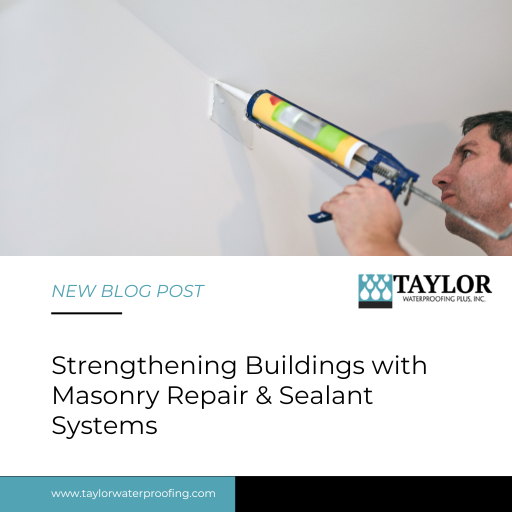
Strengthening Buildings with Masonry Repair & Sealant Systems
Introduction
Brick, stone, and masonry give buildings their timeless strength and appeal. But even the most solid walls eventually show signs of wear. Years of harsh weather—rain, heat, and seasonal temperature changes—create cracks, gaps, and surface erosion. That’s why masonry repair and sealant systems are essential. They don’t just bring back curb appeal—they guard against moisture infiltration and protect the structure for the long term.
What Causes Masonry to Break Down?
Masonry isn’t indestructible. With age and exposure, certain factors accelerate deterioration:
- Materials losing flexibility as they age
- Incompatible products used in earlier repairs
- Expansion and contraction stressing the joints
- Groundwater seeping through the foundation
- Flashing systems wearing out over time
Without intervention, these small problems worsen, allowing water to penetrate and compromise the building’s envelope.
What Masonry Repair & Sealant Systems Provide
Comprehensive repair goes well beyond filling in cracks. The goal is to strengthen and seal the building in ways that extend its life. Typical services include:
- Repointing joints with mortar designed to match the original composition
- Sealing control joints to reduce the risk of expansion cracks
- Repairing visible fractures with high-performance fillers
- Applying protective sealants to block air and water intrusion
- Using elastomeric coatings that flex with the surface while remaining breathable
Tackling Water at the Foundation
Many masonry issues begin underground, where water pressure pushes against foundation walls. To prevent these hidden threats, experts often combine masonry work with below-grade waterproofing—solutions like drainage panels or sheet membranes that redirect water away before it can reach the structure.
Case in Point: A Houston Municipal Property
One municipal facility in Houston faced serious basement flooding and stone deterioration. The solution involved a two-part strategy: reinforcing the vertical walls with masonry repair and sealant systems, and installing below-grade waterproofing around the foundation. This integrated approach kept the structure dry and stable, protecting both its appearance and integrity.
Special Care for Historic Masonry
Older buildings require extra caution. Using the wrong materials can cause lasting damage—for example, Portland cement on historic brick or stone often leads to cracking. Instead, preservation calls for lime-based mortars and breathable sealants that let moisture escape while keeping water out. For historic properties, this tailored method of waterproofing in Houston is a vital part of keeping the city’s heritage intact.
Conclusion
Masonry repair and sealant systems are a powerful combination of protection and preservation. They reinforce the structure, improve resilience, and help prevent costly damage caused by moisture. Whether it’s a commercial complex, a civic building, or a historic landmark, pairing these services with below-grade waterproofing creates long-lasting defense. With expert care, Houston properties can remain strong and secure for decades to come.